Developers call it flow state. Psychologists call it optimal experience. Vibe coders are discovering it for the first time — a mental state where you can see the entire system at once and race to describe it before it fades.
There is a moment, if you have been building something for long enough, where the pieces start to connect.
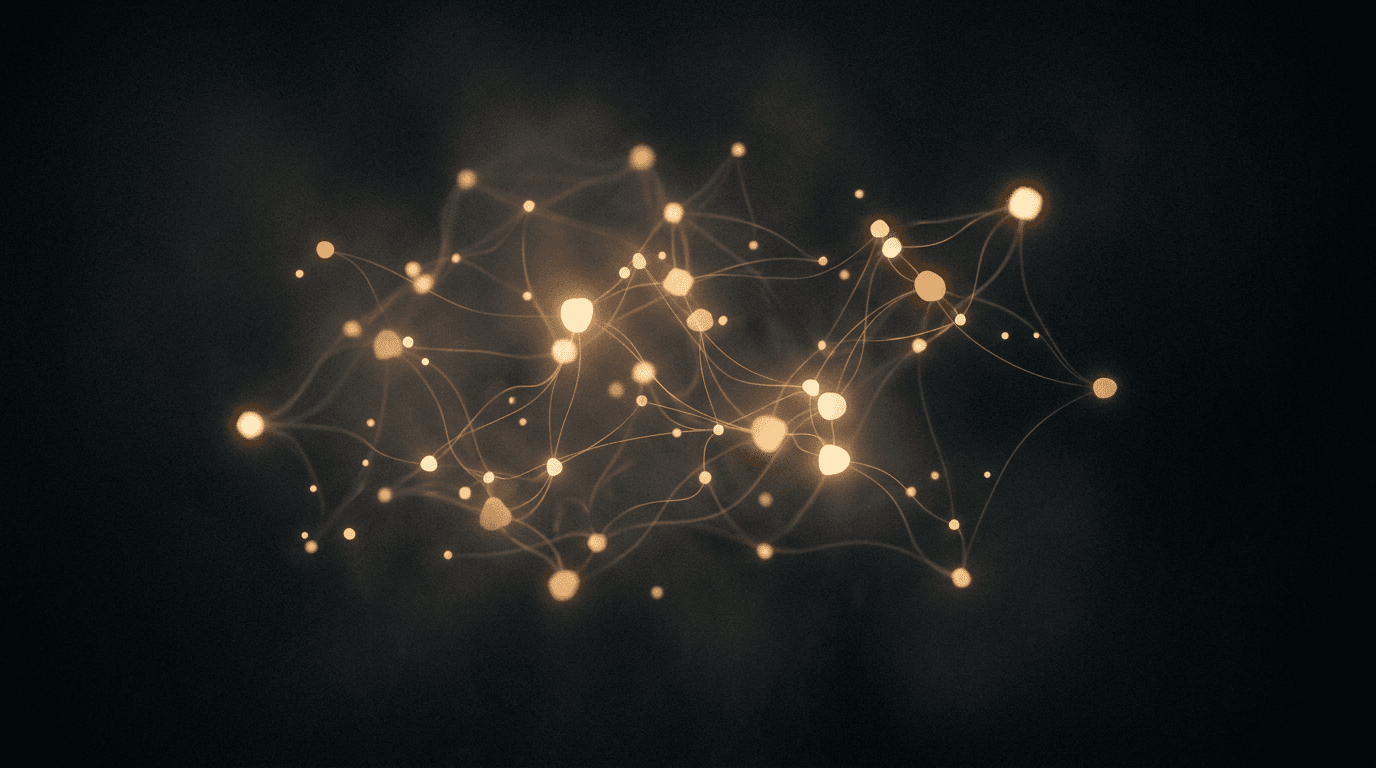
You are not looking at one thing. You are looking at all of it — the page you just built, the API it calls, the data it needs, the user who will use it, the page they will navigate to next, and the three other features that depend on the same data model. All of it is in your head simultaneously, not as a list, but as a spatial map. You can see where the lines cross. You can see the gaps.
And you are racing to get it out.
If you are speaking to an AI assistant, you are talking fast — connecting dots out loud, jumping between features, referencing things you mentioned four sentences ago. If you are typing, your fingers are behind your brain. If you are sketching, the pen is too slow.
You are in what developers call the zone.
In 1975, psychologist Mihaly Csikszentmihalyi published research on a mental state he called flow — a condition of complete immersion where the task feels effortless, time distorts, and self-consciousness disappears. The work just happens.
He spent decades studying it across professions — athletes, musicians, surgeons, chess players. What he found is that flow is not talent. It is a state that anyone can enter when four conditions are met:
When all four align, you enter the state. The mental model loads. The connections become visible. And you start moving fast.
Programmers have known about this for decades. The Social Network movie made it visual — a character with headphones on, a sticky note on the monitor: Wired In. Do not disturb.
Here is what is interesting: flow was always described as something experienced developers reached after years of practice. You had to know the language, the frameworks, the patterns — deeply enough that the mechanical parts became automatic, freeing your mind for the architectural thinking.
Vibe coding changed that.
When you describe what you want in plain language and an AI writes the code, the mechanical barrier drops. You do not need to remember syntax. You do not need to look up API documentation. You do not need to debug a missing semicolon. The low-level friction that used to prevent non-developers from reaching flow is handled by the AI.
What remains is the thinking. The architecture. The connections. The product decisions.
And that — the thinking part — is where flow lives.
So people who have never written a line of code in their lives are entering flow state for the first time. They are experiencing the spatial map, the simultaneous awareness, the racing to capture ideas before they fade. They do not know what to call it. They just know they are in something they have never felt before.
That feeling — the one where you can see multiple things at once, where connections form faster than you can articulate them, where you are speaking or typing as fast as you can to keep up with your own thinking — that is your working memory operating at full capacity.
Working memory is the mental workspace where you hold active information. It is not long-term memory (facts you have stored). It is not short-term memory (a phone number you are about to dial). It is the live, active, spatial model of the thing you are building, held entirely in your mind.
In normal conditions, working memory holds about 4-7 items. But in flow, something changes. The items are not isolated — they are connected. A "User Profile" is not one item; it is a node that links to "Settings," "Feed," "Authentication," and "Database." Each node carries its connections. The map grows. You are not holding 7 things; you are holding a network.
That network is the haze. It is not confusion. It is the opposite — it is the clearest your mind gets, because you are holding the entire system at once instead of looking at one piece at a time.
And it is fragile.
Research on programmer interruptions is stark. A study from the University of California found that after a single interruption, it takes an average of 23 minutes to fully return to the same level of focus.
Not 23 minutes to start working again — you can do that immediately. Twenty-three minutes to reload the mental model. To get the network back. To see the connections again.
Other findings:
This is why the sticky note says "Wired In." This is why developers wear headphones even when nothing is playing. The cost of breaking the haze is not a brief pause — it is 23 minutes of reconstruction, and sometimes the full model never comes back.
If you have experienced the haze, you have probably noticed something: speaking is dramatically faster than typing when you are in it.
This is not just a speed-of-input difference. It is a difference in how much of the mental model you can transfer per unit of time.
When typing, you are forced to linearize your thinking — one sentence at a time, one concept at a time. Your mind holds a spatial network, but your fingers produce a linear stream. Something gets lost in the translation.
When speaking, you can be less linear. You can jump between ideas, use comparison ("it is like Pinterest but for..."), gesture at things you have not fully articulated yet, and circle back. The AI on the other end can handle the reconstruction — it reassembles your nonlinear speech into structured output.
This is one reason voice-first tools matter for builders. Not because voice is trendy, but because when you are in the haze and seeing the connections, voice keeps up with your thinking. Typing forces you to slow down to a speed that risks losing the vision before you finish describing it.
If you are new to building products — if you came from design, or marketing, or a completely unrelated field — and you are experiencing this haze for the first time, here is what you should know:
You are not imagining it. This is a well-documented psychological phenomenon experienced by programmers, musicians, athletes, surgeons, writers, and anyone who does deep, complex work. The fact that you are experiencing it through vibe coding rather than traditional programming does not make it less real.
It is not something only developers get. Flow is about the challenge-skill balance and the nature of the work, not about the specific tool. Building a product — deciding what pages exist, how users move through them, what data flows where — is exactly the kind of complex, interconnected thinking that triggers flow. The AI handles the code; you handle the architecture. The architecture is where the flow lives.
You can learn to enter it more reliably. The four conditions are controllable:
The pieces you lose are real. When you exit the haze and cannot remember a connection you saw, that is working memory fading. It is normal. The fix is not to try harder to remember — it is to capture ideas while you are in the state. Speak them. Record them. Let the AI write them down. The product brief, the PRD, the notes — these are not bureaucracy. They are the safety net for the ideas that will otherwise evaporate when the haze lifts.
If you are building a product and you have felt the haze — even once — you have unlocked something. Here are practical ways to use it:
Protect your flow windows. Block 2-3 hours on your calendar with no meetings. The 23-minute tax means every interruption costs far more than the interruption itself. Two uninterrupted hours produce more than five fragmented hours.
Capture during, not after. When you see connections in the haze, speak them out loud. If you are working with an AI assistant, describe what you are seeing: "The profile page connects to the settings page, and both need the same user data, and the feed pulls from the same profile data, so we need a shared data layer." The AI can turn this into structured output. If you wait until after the session, you will lose half of it.
Build a product brief. The Piecemeal PRD exists specifically for this. You do not sit down and write a formal document. You capture pieces as you build — a feature here, a page there, a technical decision when it comes up. Over time, the brief becomes a map of everything you saw in the haze.
Do not force it. Flow cannot be commanded. If you sit down and the haze does not come, do not push. Do the mechanical work — fix bugs, organize files, write tests. The creative connections will come when the conditions are right.
Talk about it. If you are working with someone else — a co-founder, a designer, an advisor — describe the haze. "I was building the checkout flow and I suddenly saw how it connects to the subscription model and the email system and the onboarding." This is product thinking. It is valuable. Name it so others understand what you are contributing.
There is a misconception that building a product is about writing code. It is not. Writing code is the execution layer. The actual work — the part that determines whether the product is good — is the thinking. The connections. The architecture. The decisions about what exists, how it flows, and why.
Vibe coding made the execution layer accessible to everyone. The thinking layer was always accessible. What changed is that now, for the first time, both layers are available to the same person at the same time — even if that person has never written a line of code.
The haze is not a side effect. It is the work itself. Protect it.
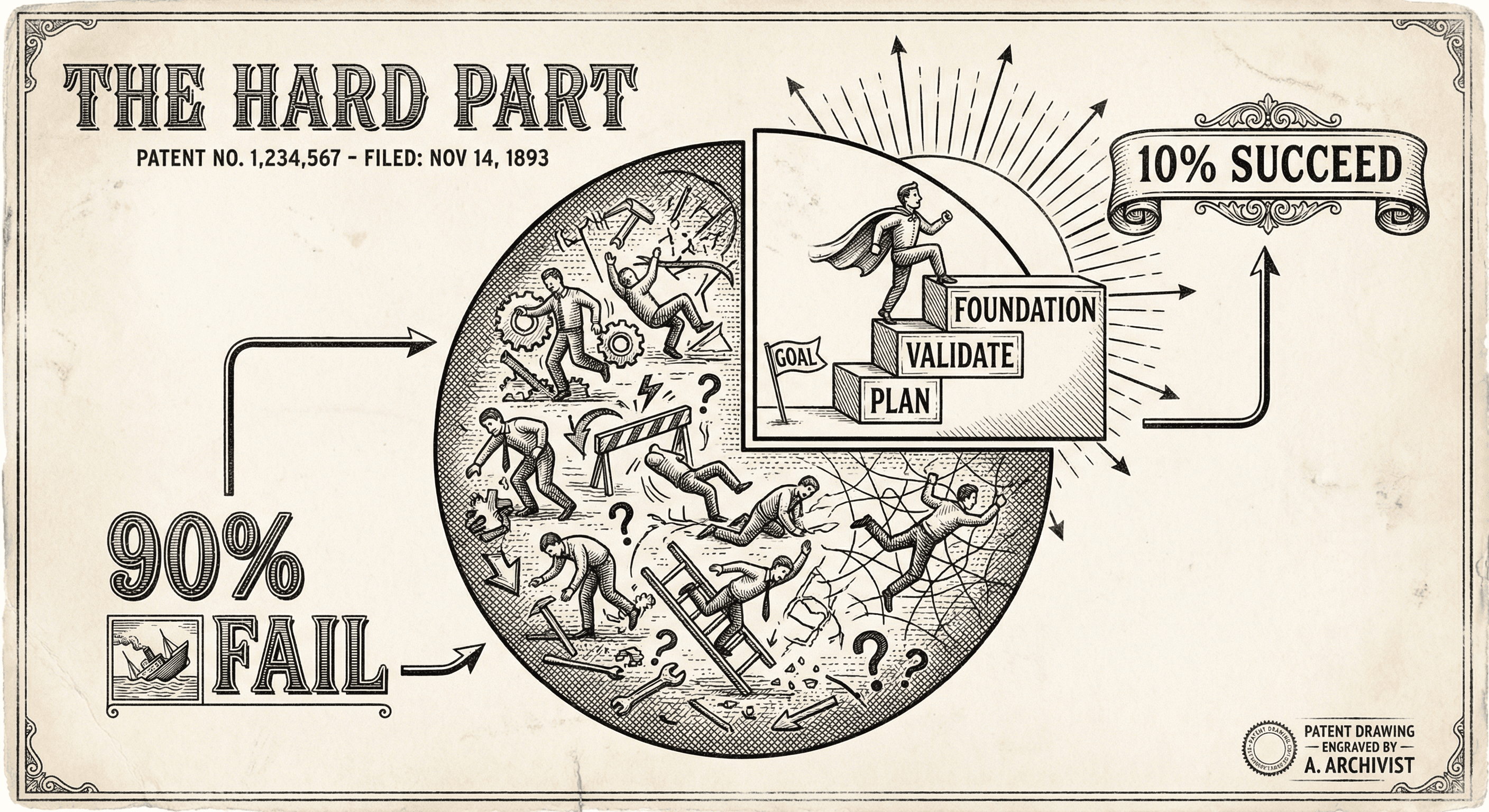
Vibe coding gets you to a working prototype fast — but most people stall there. The hard part is not the first screen. It is everything that comes after.
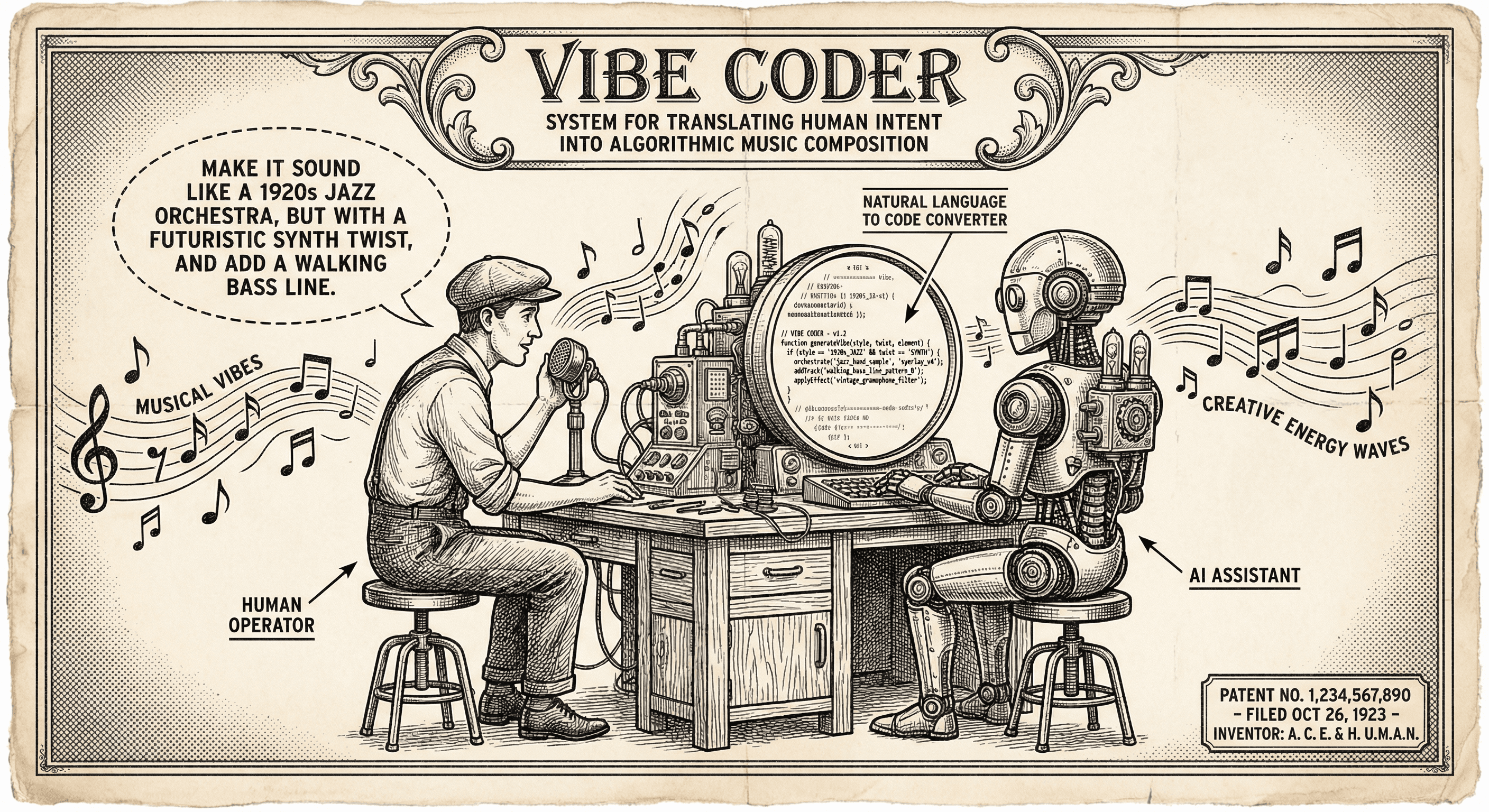
Vibe coding means describing what you want in plain English and using AI to generate or edit code. Here is what it is, who it is for, and how to use it without hitting a wall.
